

What to expect: Internal medicine residency curriculum
Our curriculum is intentionally designed to do more than prepare residents for success on the American Board of Internal Medicine (ABIM) Certification Exam. It is built to support deep, meaningful clinical immersion and long-term professional growth. Both our rotation schedule and didactic programming have been thoughtfully curated to align with the way physicians learn best: through focused, consistent engagement within a given specialty. This approach allows residents to completely invest in each clinical experience, develop stronger relationships with faculty and patients, and gain a more nuanced understanding of their field of interest.
PGY-1, -2, and -3 Block Schedules
The St. Joseph's/Candler Internal Medicine Residency Program is built around a 3+1 block schedule. For every three consecutive weeks spent on a core or elective inpatient rotation, residents have a dedicated fourth week for ambulatory training and protected time for scholarly activity, quality improvement, and research. This structure means residents can fully commit to the demands of each clinical setting. Continuity Clinic falls during the same predictable week in every cycle. The result is a training experience that is both clinically rigorous and deliberately sustainable, taking resident well-being seriously not as an afterthought but as a design principle.
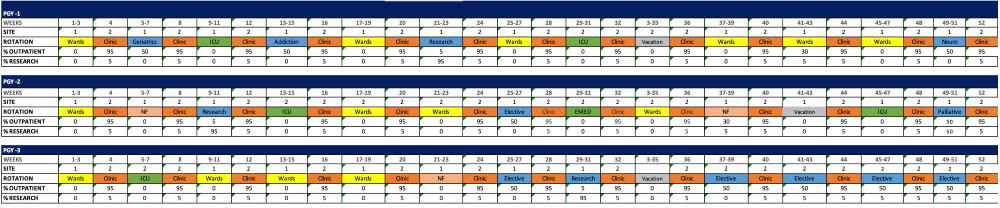
(Click image to see full document)
SJ/C Residency Program
Didactics and Academic Curriculum
Conferences
Our didactic curriculum is thoughtfully designed to provide comprehensive, high-yield education across inpatient, outpatient, academic, and professional development domains. Conferences are primarily held in person and integrated into the weekly schedule to support consistent engagement, clinical relevance, and progressive learning throughout residency.
- Morning Report anchors the educational day, with distinct inpatient and outpatient formats that emphasize case-based learning, diagnostic reasoning, and evidence-based management. Inpatient Morning Report (Monday, Wednesday, and Friday) features resident-led cases from the wards with faculty facilitation, fostering critical thinking, clinical judgment, and systems-based awareness. Outpatient Morning Report occurs daily and follows nationally recognized Yale Office-Based Medicine, focusing on common and high-yield continuity clinic presentations, preventative care, and longitudinal patient management.
- Noon Conference is held daily and serves as the backbone of the didactic curriculum. These faculty-led sessions are organized by monthly subspecialty themes and mapped directly to the ABIM certification blueprint, ensuring structured, competency-driven coverage of internal medicine topics while supporting board preparation.
- Grand Rounds exposes residents to emerging research, evolving standards of care, and complex clinical challenges through presentations by subspecialists, invited speakers, and residents.
- Morbidity and Mortality Conference promotes a culture of safety, transparency, and quality improvement through resident-led case discussions focused on systems-based practice and patient safety.
- Journal Club develops residents’ skills in critical appraisal of medical literature through faculty-mentored, resident-led discussions of contemporary research.
- Simulation and POCUS sessions reinforce hands-on learning where residents practice high-stakes clinical scenarios, procedural skills, bedside ultrasound, and team-based care in a dedicated simulation environment, with structured debriefing and formative feedback.
- Dedicated Board Review sessions are integrated throughout training, increasing in frequency during the third year. These sessions use interactive formats, including Jeopardy-style reviews and MKSAP-based question sessions aligned with monthly subspecialty themes, complemented by annual In-Training Examination (ITE) performance to guide individualized study plans.
- Interdisciplinary Resident/Fellow Core Curriculum is a weekly virtual series focused on ACGME core requirements, professionalism, quality, safety, and healthcare systems. Sessions are led by institutional leaders and faculty, recorded for flexibility, and designed to prepare residents for leadership within complex healthcare environments.
Didactics at a Glance
Morning Report (Inpatient)
Mon/Wed/Fri on hospital rotation, 7–8am
Resident-led inpatient cases with faculty facilitation, emphasizing diagnostic reasoning, evidence-based management, and systems-based practice.
Morning Report (Outpatient)
Daily in Continuity Clinic, 7–8am
Case-based ambulatory conference following Yale OBM, focused on continuity clinic, prevention, and longitudinal care.
Noon Conference
Daily, 12–1pm
Faculty-led, ABIM-mapped didactics organized by monthly subspecialty themes.
Grand Rounds
Monthly, 12–1pm
Advanced topics, emerging research, and complex clinical challenges presented by faculty, subspecialists, guest speakers, and residents.
Morbidity & Mortality (M&M)
Monthly, 12–1pm
Resident-led case reviews promoting patient safety, systems improvement, and reflective practice.
Journal Club
Monthly, 12–1pm
Resident-led critical appraisal of contemporary internal medicine literature with faculty mentorship.
POCUS & Simulation
Alternates monthly, 1–5pm
Hands-on training in high-stakes scenarios, procedural skills, bedside ultrasound, and team-based care with structured debriefing.
Board Review
Longitudinally Integrated
Interactive Jeopardy-style reviews, MKSAP-based sessions, and annual ITE-guided study planning.
Interdisciplinary Resident/Fellow Core Curriculum (IRCC)
Weekly September–March, Wed 12–1pm | Virtual (Live & Recorded)
ACGME-focused curriculum led by institutional and GME leaders at MCG Augusta addressing professionalism, quality, safety, and healthcare systems.