
Family Health
What is a neonatologist?
Key Takeaways:
- A neonatologist is a specialty-trained physician that cares for sick and vulnerable babies.
- Neonatologists mostly care for babies in our Special Care Nursey, but they also attend high-risk deliveries.
- At St. Joseph’s/Candler, our neonatologists are in the hospital 24 hours a day, seven days a week, 365 days a year.
- Neonatologists also care for parents by offering emotional and education support.
These highly-trained physicians are here 24-hours a day, seven days a week to help our tiniest and sickest patients
If your baby is born prematurely or develops a problem after birth, your newborn most likely will require a stay in our Level II Neonatal Intensive Care Unit (NICU), also called the Special Care Nursery, at Candler Hospital.
It can be a scary and unexpected experience for parents, but we have a highly-trained and compassionate staff around the clock to take care of your baby.
That includes neonatologists. A neonatologist is a specialty-trained physician to care for the most vulnerable and sick babies, whether born prematurely, have some type of infection or birth defect or one who develops a condition that needs special care following birth, such as jaundice, explains Dr. Josef McLean, neonatologist and director of neonatology at St. Joseph’s/Candler.
Related Article: How to treat jaundice in newborns
“Most people think babies are born good to go, but babies get sick too, and they need specialized doctors," Dr. McLean says. “Unlike adults and children, babies can’t tell you they are getting sick, so you need specialized training to pick up on that and care for them.”
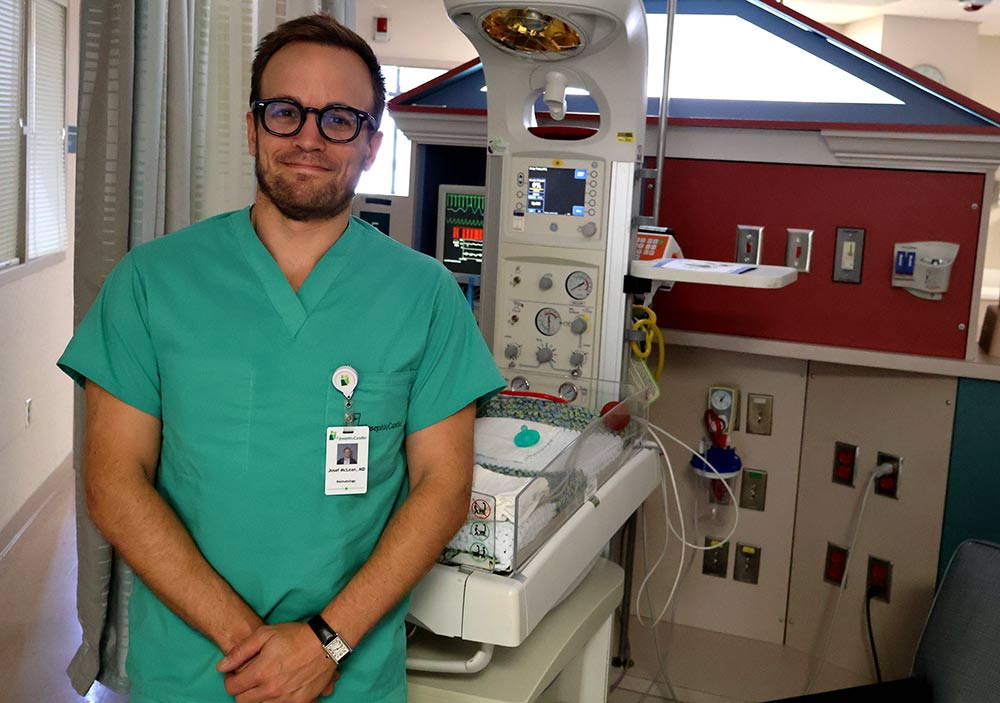
Our neonatologists also attend high-risk deliveries, including all planned, scheduled C-sections. Your OB will still deliver the baby, but the neonatologist is right on hand if any immediate problems occur.
And, our neonatologists work 24-hours a day, seven-days a week at Candler Hospital to always be available for high-risk deliveries or any needs that arise with our babies in the nursery, as well as on the Mother-Baby unit.
“I don’t think people realize we are here, but I do think they appreciate that when we have to come care for their baby, we are there pretty quickly,” Dr. McLean says. “Time is of the essence, especially at deliveries. Babies are resilient until they are not.”
There’s a lot of training that goes into taking care of sick newborns. To become a neonatologist, you complete medical school and then do a three-year residency in pediatrics followed by another three years of fellowship training in neonatology before you can begin to practice on your own, explains Dr. McLean, who’s been practicing at St. Joseph’s/Candler for more than seven years.
“It’s nothing like normal medicine. Newborns have different lab values, different tolerance for things; even an EKG is different, at least for the first few days compared to a normal EKG,” Dr. McLean says. “It’s a very rewarding job to do. I love it, and I love working here.”
While our neonatologists are on staff to take care of our vulnerable newborns, they also work with parents, providing emotional and educational support. Dr. McLean understands that even what may appear as a minor setback to him as a physician, feels like a major setback to the parents.
“I think we are really focused on caring for moms and families too. You can’t have a baby do well if he doesn’t have anywhere to go home to,” Dr. McLean says as an example. “We really want to make sure everyone goes home safe and with understanding, especially our first-time moms and babies that are leaving the NICU. Some of these babies are complex or feeding differently or still premature.”
The Telfair BirthPlace offers rooming-in where parents can spend time with their baby either in a semi-private room in the NICU or in the hospital to get comfortable with the baby before going home. The babies are still monitored, Dr. McLean explains, but the parents are doing all the feedings, changing diapers, and the medical staff is there in case they need help or have questions.
And Dr. McLean encourages parents to not be afraid to ask questions during any part of their journey, whether it’s by attending one of our birthing classes or asking for a pre-delivery consultation with a neonatologist or before going home with your newborn.
“We really want to make sure everyone gets home safely and has the resources they need when they get home,” Dr. McLean says.