
Family Health
How do I talk to my parents about hearing loss?
Key Takeaways:
- More than 37 million American adults suffer from some degree of hearing loss
- Asking people to repeat themselves, difficulty understanding words in background noise and avoiding social situations are just a few signs of hearing loss
- Hearing aids have drastically improved and reduced in size over the years
- A St. Joseph’s/Candler audiologist can help determine your degree of decline and treatment options
- Time to talk to your parents about hearing loss? Be supportive and follow the suggestions below.
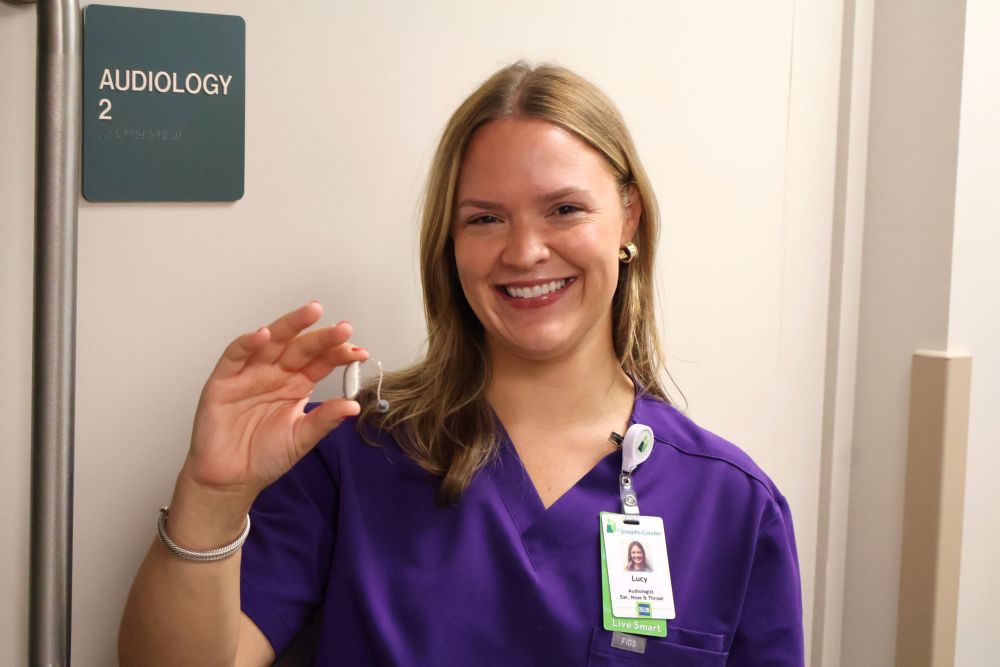
St. Joseph’s/Candler Audiologist Lucy Bradshaw explains the warning signs of hearing loss and how you can talk to mom or dad about it
Is dad turning up the television extremely loud, at least in your opinion, in order to hear the game?
Have you noticed mom avoiding social events she once cherished attending?
Maybe you find yourself almost screaming at your parents in order to communicate with them while at a restaurant.
These are just some of the signs your loved one may be experiencing hearing loss.
Our audiologists at St. Joseph’s/Candler – Georgia Ear, Nose & Throat Specialists know it’s difficult when you realize your loved one’s hearing just isn’t the same as it once was. But, you’re not alone. We hear about it from people every day.
In fact, it’s most likely that all of us at some point in our lifetime will experience some degree of hearing loss, says St. Joseph’s/Candler – Ga. ENT Specialists Audiologists Lucy Bradshaw, Au.D., CCC-A.
According to the National Institute on Deaf and Other Communication Disorders, which is part of the National Institute of Health (NIH), approximately 15 percent of American adults, or roughly 37.5 million people, report some degree of hearing problems.
“And that just increases as we age,” Bradshaw adds. “Hearing loss is known to become more prevalent throughout our lifespan whether that’s due to physical physiological or genetics or environmental factors.”
Related Article: Five things to know about adult hearing loss
What are the signs of hearing loss?
Some of the signs and symptoms you can look out for, Bradshaw says, include:
- Difficulty understanding words in background noise, such as restaurants
- Needing to turn up the volume on the TV or radio
- Unable to carry out conversations on the phone
- Frequently asking people to repeat themselves
- Perception that others are mumbling or not understanding some of the words they are saying
- Avoiding social situations
- Ringing, humming or bussing in the ear
- Dizziness or loss of balance
If you start to notice any of these signs or have already seen them in either of your parents, Bradshaw says start by being as supportive as possible.
“We all can be stubborn in our ways sometimes, and for some, it’s hard to admit there’s a problem,” Bradshaw says. “Be supportive by offering to go to their hearing appointment with them. We encourage our patients to bring a support individual with them because it tends to put them more at ease.”
Other things you can do if you are noticing a hearing decline are:
- Get their attention with a hand gesture or tap on the shoulder before verbal communication
- Face them directly when speaking
- Don’t speak too loudly or scream at them; instead, Bradshaw recommends speaking in a clear tone.
- Enunciate and really move your mouth and even your hands when talking
- Reduce background noise as much as possible
“I know sometimes it can be stressful, and we can all get into heated conversations, but try to stay as calm and supportive as possible so you affect the conversation in a positive way,” Bradshaw says.
The current state of hearing aids
One of the biggest reasons Bradshaw finds some people are hesitant to hearing tests is because they don’t want to wear hearing aids. Still a common misconception is that hearing aids are large, bulky devices that everyone will see.
That’s no longer the case.
“It’s so amazing how small they are,” Bradshaw says. “Hearing aids have not only physically improved on a smaller scale, but also the internal components of how hearing functions and what all we can do to manipulate the settings has increased and improved drastically over the years.”
Bradshaw says most of her patients are amazed at the size of today’s hearing aids. Many come to their next appointment realizing a family member or fellow church goer is wearing the same hearing aid, and the patient had no idea.
“They are a whole lot more discreet now,” Bradshaw says. “If the cosmetic component of a hearing aid is a hinder, you should know they are more appealing nowadays.”
What to expect at an audiologist visit
Bradshaw encourages all adults to have a hearing test with an audiologist, even if you don’t feel there’s a decline. If nothing else, it will give you and the audiologist a baseline for future testing.
Most appointments with our audiologists are about 30 minutes long and began with a medical and hearing history to get a better understanding of what may be going on with your hearing. Then the audiologist will run a few test examining not only your hearing but also your speech and comprehension.
That will give the audiologist a good idea of how well you are receiving speech and what you are and are not hearing. Then, more testing or treatment can be recommended.
A bonus of seeing an audiologist with Georgia Ear, Nose & Throat Specialists, is we have board-certified and fellowship-trained physicians right in the office that can further diagnose and treat complex ear problems.
The SJ/C – Ga. ENT Specialists office is located in the Heart & Lung Building on the Candler Hospital campus. For more information, visit our website or request an appointment with an audiologist today.