
Cancer
Treating lung cancer at the Lewis Cancer & Research Pavilion takes a team
Key Takeaways:
- Treating lung cancer is a team effort that can include pulmonologists, cardiothoracic surgeons, radiation oncologists, medical oncologists and others
- Lung cancer is one of the most common cancers diagnosed
- St. Joseph’s/Candler has Monarch Robotic Bronchoscopy to find, biopsy and mark suspected lung cancer nodules
- Using the da Vinci Robotic Surgical System, our cardiothoracic surgeon can remove those nodules in most cases
- Some people may not be a candidate for surgery or require additional treatment such as radiation therapy, chemotherapy, targeted therapy or immunotherapy
St. Joseph’s/Candler and the LCRP have highly skilled, experienced providers to tackle your lung cancer diagnosis
Winning a Super Bowl, the FIFA World Cup or the World Series requires what? A really good team.
And so does diagnosing and treating your lung cancer. That’s what you can expect as a patient at the Nancy N. and J.C. Lewis Cancer & Research Pavilion – whether you are treated in Savannah, Bluffton, Hinesville or any of our other locations.
When it comes to treating lung cancer, it’s not a job for just one specialist. Our patients are treated by physicians who serve on multidisciplinary tumor boards and collaborate to design personalized treatment plans for each patient.
“No single physician holds the complete answer to lung cancer,” says Dr. Gary Thomas, medical oncologist with St. Joseph’s/Candler – SC Cancer Specialists. “This is truly a team effort.”
Lung cancer is one of the more common diseases we treat at the Lewis Cancer & Research Pavilion. That’s because it’s one of the most common cancers diagnosed. In fact, it’s the second most common cancer diagnosis and the leading cancer killer in both men and women.
Lung cancer causes more deaths each year than colon, breast and prostate cancer combined,with an estimated 124,990 deaths and 229,410 new diagnoses expected in the U.S. in 2026, according to the American Cancer Society.
But, when caught early, it is treatable.
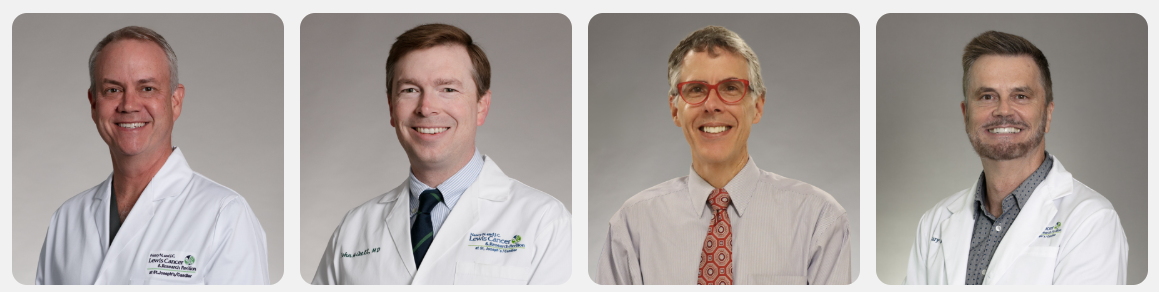
Pictured above (l-r): Dr. Marc Bailey, Dr. John Mikell, Dr. Doug Mullins and Dr. Gary Thomas
How treating lung cancer takes a team approach
When a nodule is discovered on your lung, typically through imaging, the first step is to evaluate it. At St. Joseph’s/Candler that involves one member of our team, Dr. M. Douglas Mullins, pulmonologist with Southeast Lung Associates and medical director of the Advanced Thoracic Oncology Center. He uses an advanced robotic bronchoscopy system called Monarch.
“The Monarch technology allows me to navigate the lung’s narrowest airways with extreme stability and precision,” Dr. Mullins says.
Dr. Mullins guides the Monarch robot to the nodule with imaging and performs a biopsy to determine if it’s cancerous. He also places a marker called a fiducial, which acts as a microscopic navigation tool that leaves a clear roadmap for another member of your lung cancer team, St. Joseph’s/Candler Cardiothoracic Surgeon Dr. Marc Bailey, who works closely with Dr. Mullins at the Advanced Thoracic Oncology Center.
Related Article: Tiny technology helps find and remove small, peripheral lung cancers
Dr. Bailey removes the abnormality at the site of the marker through minimally-invasive surgery with the da Vinci robot.
“Through this unified approach, we can diagnose, stage, and treat early-stage lung cancer all in one setting," Dr. Bailey says. "About 95 percent of these early-stage patients go home the very next morning.”
Related Article: What is robot-assisted surgery?
In addition to surgery or if a patient is not a good candidate for surgery, other treatments may include radiation therapy and/or chemotherapy, targeted therapy or immunotherapy. St. Joseph’s/Candler currently has three radiation oncologists who see patients in Savannah, Bluffton and Hilton Head and are also part of your lung cancer treatment team.
With the use of radiation therapy, our doctors use advanced CT and PET imaging to pinpoint the tumor’s dimensions and locations. Then using technology like TrueBeam, radiation beams target the tumor while preserving surrounding tissue.
“We can destroy the cancer cells with incredible precision and accuracy,” says Dr. John Mikell, St. Joseph’s/Candler radiation oncologist.
If your lung cancer also requires chemotherapy or immunotherapy, it may be administered at the same time as radiation therapy.
“This requires seamless and efficient coordination,” Dr. Mikell says. “We work hand-in-hand with our medical oncology colleagues to ensure each patient's care is as effective as possible.”
The Lewis Cancer & Research Pavilion has a number of outstanding medical oncologists that may be on your lung cancer team, including physicians in Savannah, Hinesville, Pembroke and Statesboro, as well as Bluffton and Hilton Head, S.C. They all work closely with not only the radiation oncologists, but Dr. Mullins and Dr. Bailey as well.
“They are excellent physicians, and we all collaborate very well,” Dr. Thomas says. “Most importantly, patients get all the treatments right here at home.”