
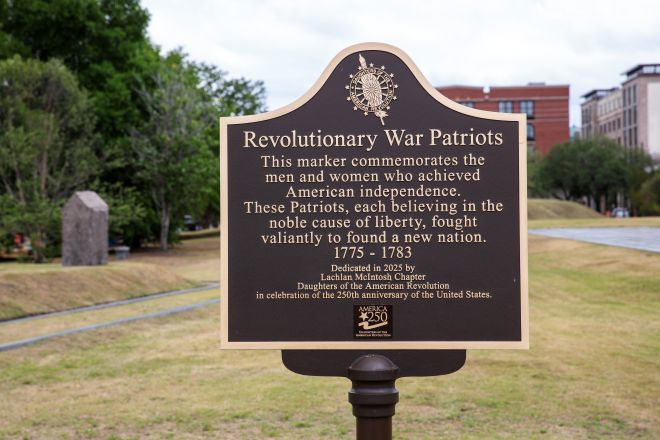
Learn the role that Savannah played in the Revolutionary War
In honor of America's 250th, Senior Historian with the Georgia Historical Society explains how Georgia's oldest city helped shape our future
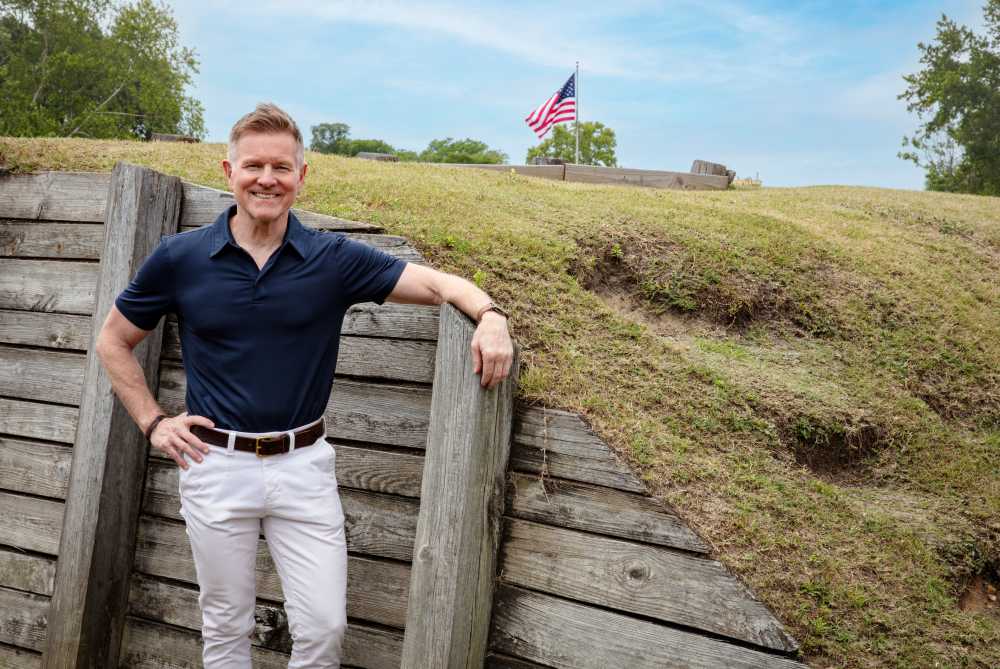
This Independence Day, the traditional fireworks, parades and cookouts will be imbued with a deeper resonance as the nation celebrates two and a half centuries of a republic that many believed would fail. This significant milestone may have Savannahians asking themselves, “What was our part?”
The answers can often be found beneath our feet.
“There are many ways to absorb the Revolutionary War in Savannah,” says Dr. Stan Deaton, Senior Historian with the Georgia Historical Society and Emmy-winning writer and host of Today in Georgia History. “Of course, sometimes the place you’re visiting looks nothing like it did. But I like knowing where things happened, even if it’s been paved over for a parking lot.”
Deaton says that visitors, or Savannahians who enjoy being tourists in their own city, just need to use a little imagination.
“There were no immaculate squares or palatial homes in Savannah back then,” Deaton says. “But you can walk in the places where things happened. Broughton Street, for example, was very much the commercial center of Savannah in the late 1700s. As much as the street has changed, any time you are walking down Broughton, you are walking down 18th-century Savannah.”
Continue reading below
The Siege Of Savannah
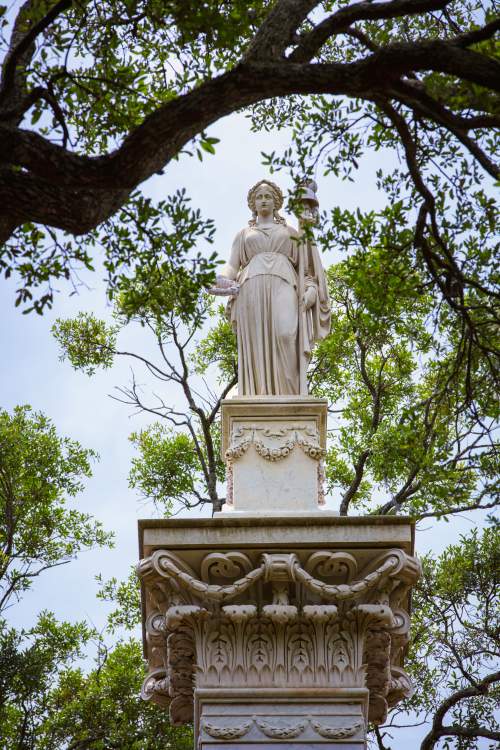
Walk south from Broughton down Martin Luther King Jr. Boulevard to Liberty Street and you will find Battlefield Memorial Park, which serves as a memorial for the Siege of Savannah, one of the bloodiest battles of the Revolutionary War.
“Up until about 1778, most of the war had taken place in New England or the mid-Atlantic states,” Deaton says. "But they had reached a kind of stalemate, so the British Army shifted strategy to focus on southern colonies, which included capturing Savannah.”
Ten months later, American forces endeavored to take the city back, with assistance from the French military.
“On October 9, 1779, the American and French allies launched an assault,” Deaton says. “But, quite frankly, the British knew they were coming and were dug in pretty well.”
The allies lost about 1,000 men in the attack, including General Casimir Pulaski, who was shot as he charged on horseback through a breach in the British line.
“Battlefield Memorial Park seems like a quiet little corner of a busy street in a tourist town,” Deaton says. “But as you walk the grounds, give yourself a moment to really think and imagine what happened on that foggy morning.”
The loss at the Siege of Savannah determined the direction of the war in the southern colonies—for a time. Following a catastrophic defeat in Yorktown, Virginia, in 1781, the British Army ended its offensive operations. They evacuated Savannah in 1782.
“The British thought they could pluck this leaf from the American tree, but they couldn’t kill that spirit,” Deaton says.
Letters To The Future
If you want to learn more about General Pulaski and other heroes of the Revolutionary War, you can find their monuments and markers as you explore Savannah’s famous squares. The Pulaski monument, completed in 1854, stands in Monterey Square. It honors the Polish nobleman who became a brigadier general in the Continental Army and has been called the “father of American cavalry.”
Another fatality of the Siege of Savannah was Sergeant William Jasper, an American soldier known for his bravery serving in the 2nd South Carolina Regiment, most notably at the 1776 Battle of Sullivan's Island, where he risked his life under heavy fire to replace the fallen American flag at Fort Moultrie. Jasper’s monument was unveiled in Madison Square in 1888.
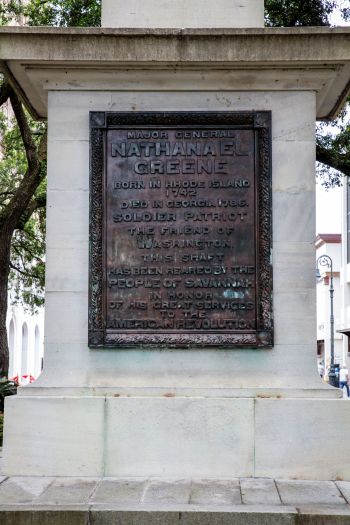
In Johnson Square, you can find the monument of Major General Nathanael Greene, known as a brilliant Continental Army officer and George Washington's most trusted general. He is credited with forcing the British forces out of Georgia and the Carolinas. As a reward for his service, Georgia granted Mulberry Grove Plantation to Greene. He died there in 1786. The cornerstone of Greene’s monument was laid in 1825 by Greene’s friend and fellow war hero, the Marquis de Lafayette.
The Georgia Historical Society has administered the state’s historical marker program since 1998, maintaining older markers and erecting about 300 new ones across Georgia. Deaton sees these markers and monuments as a bridge from the past to today, as the American experiment is still ongoing.
“I think of these as letters to the future,” he says. “We want future generations to know about these people and places. Because the great legacy of the revolution is that we’re now the world’s oldest self-governing republic. At the time, this was not inevitable. Many believed it wouldn’t last.”
All of these markers and more can be explored virtually through the Georgia Historical Society’s interactive database, available at georgiahistory.com.
A Continental Movement
Visitors can explore Savannah’s ties to the revolution even further. You can trace George Washington’s visit to the city in 1791, and see where he lodged, dined and worshipped. You can see the memorial to Button Gwinnett, one of the three Georgians who signed the Declaration of Independence, in Colonial Park Cemetery (though his exact resting place there is unknown). You can learn about just how young Georgia was as a colony, and how remarkable it is that its leaders chose to stand with the others.
“Georgia didn’t have the long-established traditions of governing that places like Virginia and Massachusetts did,” Deaton says. “But their leaders understood that this was a continental movement. When it came time to write a constitution in 1777, Georgia chose to be a republic, and that’s no small thing.”
Did you know that advances in medicine during the Revolutionary War helped shape healthcare for generations to come? These new practices most certainly influenced caregivers at Candler Hospital, which was founded in 1804, only 21 years after the war. Learn more here.
Smart Health, Smart Living - The Latest Delivered to You
Want more health stories on topics that impact the health and wellbeing of you and your family? Learn about new technology, treatment options and how you can live a smarter, healthier life in our Smart Living publication.