
Cancer
Treating colon cancer is an individualized approach
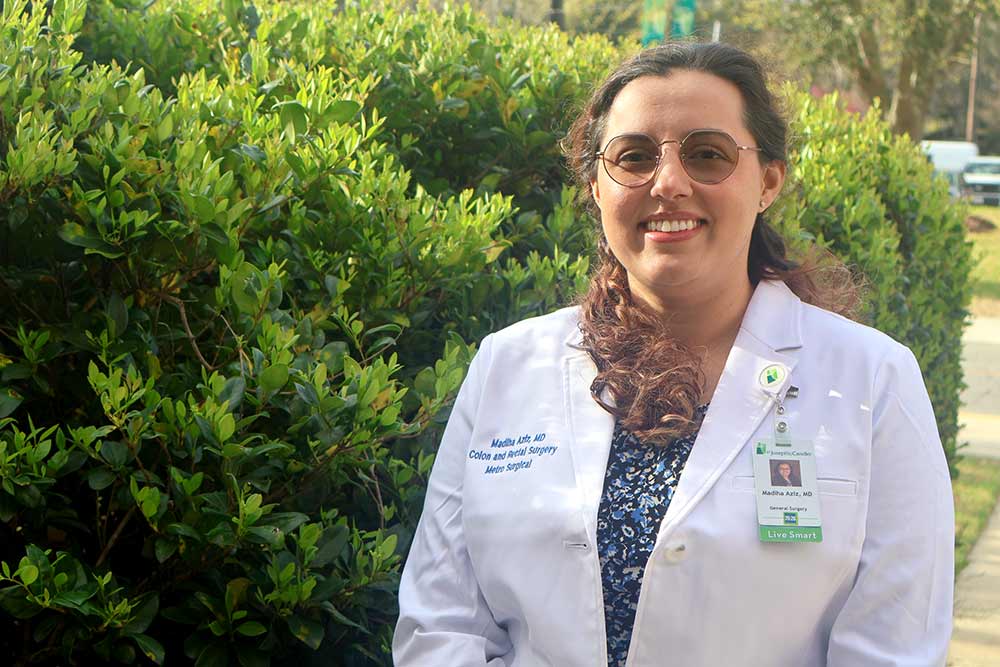
Savannah colorectal surgeon Dr. Madiha Aziz explains the possible treatment options you may face if diagnosed with colon cancer
You just found out you or a loved one has colon cancer. Now it’s time to consider your treatment options. At St. Joseph’s/Candler and the Nancy N. and J.C. Lewis Cancer & Research Pavilion, we take a personalized approach to treating cancer.
“Before, colorectal cancer treatment was really one size fits all because that’s just the tools we had at the time,” says Dr. Madiha Aziz, colorectal surgeon with Metro Surgical. “Now, our understanding of cancer has advanced and our treatment options, especially with many new targeted chemotherapy agents, has really advanced. We can give a more tailored treatment for each patient’s specific type of cancer. It’s individualized to your tumor.”
Colorectal cancer is the third most common cancer diagnosed in both men and women in the United States, excluding skin cancer, according to the American Cancer Society. Additionally, colorectal is the third leading cause of cancer-related deaths in men and fourth-leading cause in women.
While the death rate from colorectal cancer has been dropping in older adults over the past decade, we are seeing a sharp increase in diagnoses and deaths from colorectal cancer in people under 55. That’s one reason why colorectal screening through colonoscopy is now recommended at age 45 for the average-risk person.
A colonoscopy allows physicians to find polyps – a small clump of cells on the lining of the colon and rectum – and remove them before they develop into cancer or the cancer is detected earlier when it is easier to treat.
Related Article: Six frequently asked questions about colonoscopies
Treating colon cancer
If a mass is discovered during screening, it will be biopsied to determine if it’s cancerous or benign, explains Dr. Aziz, who also performs colonoscopies. If it is malignant, your treatment plan will be determined by location, size and stage of the tumor.
A majority of colon cancers can be treated with surgery. Dr. Aziz is trained in minimally-invasive robotic surgery to remove cancer in the colon. She can also do laparoscopic or open procedures, but the majority of surgeries are performed with the da Vinci Robotic Surgical System, which is available at St. Joseph’s/Candler.
“I really like to use the robot, especially for working in the pelvis,” Dr. Aziz says. “The way that the pelvis is, it can be viewed as a box made out of bone. The robot helps ensure visualization and meticulous dissection in the tight space while limiting our incision size. This helps ensure optimal cancer outcomes and a less painful, more rapid return normal for the patient. I think the robot is invaluable for the pelvis."
Related Article: What is robot-assisted surgery?
Typically following a minimally-invasive colorectal surgery, you will stay in the hospital for at least a day and sometimes up to five days. Dr. Aziz prefers this to ensure her patients are eating OK, having bowel function and safely moving around.
In addition to surgery, some patients may need some form of chemotherapy, especially if the cancer has spread to the lymph nodes or elsewhere, Dr. Aziz says. The chemotherapy may come before or after surgery, which again is personalized to each individual patient. In colon cancer specifically, radiation therapy isn’t typically needed, Dr. Aziz says.
Additionally, your healthcare team may recommend genetic counseling. Any tumors removed in colorectal cancer are not only biopsied, but also sent for gene analysis. That’s the new standard of care, Dr. Aziz says.
The analysis will look at the tumor markers and gene expressions to determine your risk of not only colon cancer, but also endometrial cancer and thyroid cancer, Dr. Aziz says. This is not only important for you to know so you are getting all the proper screening, but your children can also get genetic counseling and may need to start screening earlier.
“We’ve really come a long way in learning about and treating colorectal cancers,” Dr. Aziz says. “I think we are just going to keep pushing and pushing that boundary, and I’m really excited about it.”
Related Article: Should I see an oncology genetic counselor?
Three things you can do for good colorectal health
Yes, Dr. Aziz is a colorectal surgeon, but that doesn’t stop her from offering advice to hopefully never need surgery for a malignant or benign condition of the colon or rectum. She says there are three things you can do for good colorectal health
- Get your colonoscopy when it’s time. For average-risk people that’s 45. For most, that’s every 10 years. However, if your doctor recommends colonoscopy every three years or five years, listen to that advice. Finding polyps and removing them before they become cancer can be life-saving.
- Get plenty of fiber in your diet. Fiber is found in most vegetables and fruit skins. The minimum recommendation is 30 grams per day. Along with that, be sure to drink at least 64 ounces of water.
Related Article: Fiber: The unsung hero in digestion, lowering cholesterol and even cognition - Don’t be afraid to reach out for care. You know your body better than anyone, and if you suspect something is wrong, you should be evaluated. “If you see blood in your stools, that’s not normal. See me, see a gastroenterologist or see your primary care provider; just see someone.”