

What is targeted therapy?
St. Joseph's/Candler SC Cancer Specialists Medical Oncologist Dr. Gary Thomas explains how advancements in medical oncology are leading to a new level of individualized treatment
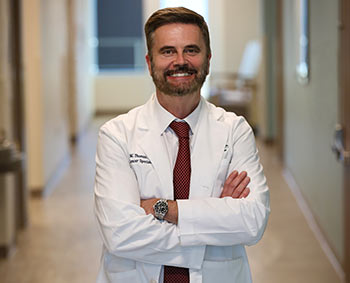
Like any battle, the fight against cancer takes courage, resilience, and tirelessness. Physicians and caregivers hope to go into that battle with the latest, most advanced weapons.
For certain types of cancer, medical oncologists now have the equivalent of a guided missile in their arsenal. It’s an approach called targeted therapy.
“Through various tests and gene analysis, we can pinpoint if a certain case of cancer is driven by a particular mutation, and that is what we will target,” explains Dr. Gary Thomas, board-certified medical oncologist and Medical Director at St. Joseph’s/Candler SC Cancer Specialists. “The drugs can be both more effective and less toxic to the patient.”
The unprecedented precision of targeted therapy is delivered through a variety of drug types and is commonly used for cancers like breast, lung, colorectal, and certain types of leukemia.
A Range Of Possibilities
There are several types of targeted therapy, each with a unique mechanism for fighting cancer. These include:
Small-Molecule Inhibitors
A class of drugs called small-molecule inhibitors can slip inside cancer cells and dismantle their inner workings. Kinase Inhibitors target proteins called kinases, which act like internal switches that tell a cell to grow, divide, or survive. In cancer, these switches are often stuck in the ON position. The inhibitors physically fit into the active site of the kinase switch, preventing it from functioning. By blocking the signal, they force the cancer cell to stop growing and eventually die.
Proteasome inhibitors target a protein complex called the proteasome, which acts as a cell's garbage disposal. Cancer cells are typically very busy, generating lots of faulty proteins that need to be broken down. By jamming the proteasome, these drugs cause the abnormal proteins to build up inside the cancer cell, eventually overwhelming and killing it.
Poly-ADP ribose polymerase, or PARP, is a family of proteins that is targeted by a class of drugs called PARP inhibitors. Cells use PARP to repair damaged DNA. The inhibitors block this last line of defense against DNA damage in cancer cells that are already genetically weak. Without this backup repair system, the cancer cell’s DNA damage becomes too extensive, and the cell self-destructs. They are used for some ovarian, breast, prostate, and pancreatic cancers.
Monoclonal Antibodies
Another targeted therapy approach uses large proteins made in a lab that act like natural antibodies in the immune system. These are called monoclonal antibodies.
Surface receptor blockers target specific receptors that sit on the surface of cancer cells. Cancer cells often have too many of these receptors, which constantly receive signals to grow. These antibodies physically attach to the receptor, blocking the growth signals from reaching the cell's interior.
Another type of monoclonal antibody is known as an anti-angiogenesis inhibitor. These drugs target a protein called Vascular Endothelial Growth Factor, or VEGF, which a tumor releases to build its own blood supply. Anti-angiogenesis inhibitors prevent new blood vessels from forming and may even damage existing ones. By starving the tumor of oxygen and nutrients, they slow or stop its growth.
More Options, Individualized
Small-molecule inhibitors and monoclonal antibodies are just some of the many targeted therapy options available to certain cancer patients today. The arsenal is large and diverse in order to match the different mutations across various cancers. For Dr. Thomas and his staff, having these options is essential to delivering individualized treatment, with precision medicine as a guiding force.
“The days when every cancer patient would go to an oncologist and automatically receive chemotherapy are over,” Dr. Thomas says. “That’s history. We are continuously looking for novel ways to treat cancer, and I predict that treatment options, with improved outcomes, will increase over the next five to ten years.”
There will still be some patients for whom conventional chemotherapy is the most appropriate treatment. But Dr. Thomas understands that every patient’s cancer journey is different, and treatment is tailored to each patient’s individual needs.
“I talk with every one of my patients about their goals, and we have what I call a shared decision-making discussion,” Dr. Thomas says. “I tell people that I'm their point guard. And as the point guard, I have great relationships with surgical oncologists, radiation oncologists, pathologists, and everyone who is a part of your cancer care team. We all work together. And we’re blessed that at St. Joseph’s/Candler, we have a really strong team.”
Smart Health, Smart Living - The Latest Delivered to You
Want more health stories on topics that impact the health and wellbeing of you and your family? Learn about new technology, treatment options and how you can live a smarter, healthier life in our Smart Living publication.