Share your story
Want to share your cancer journey with us? We'd love to hear it. Please fill out this quick form and someone will be in touch with you soon.

Jo Frayler’s cancer journey began 20 years ago.
She was just 48 when she was first diagnosed with breast cancer. She elected to have a bilateral mastectomy with reconstruction. She did extremely well, she says, and thought it was behind her.
Then in 2014, after moving to Bluffton, South Carolina, Jo was at her doctor’s office after hurting her back when a lump was discovered near her armpit. This time, the cancer cells were in her pectoral muscle. Jo had the muscle removed and underwent chemotherapy and radiation therapy.
“I don’t have any other medical conditions. We thought I was doing great,” Jo says. “Then unfortunately at the beginning of this year, we found it was metastatic and in my bones.”
“Honestly, the first time, I never thought it was going to come back. The second time, it was only in my pectoral muscle, and it wasn’t metastatic so I thought it was going to be OK,” Jo says. “This time knocked me for a loop. To hear it was metastatic – I was shocked. I was angry. It immediately set me into a downward spiral. But I have a daughter, and I have to stay positive for her.”
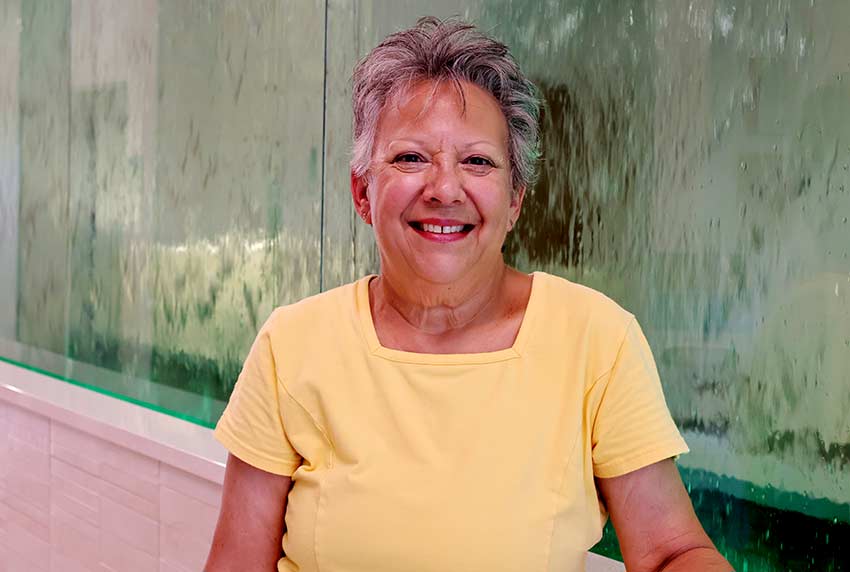
Since she’s already had surgery, reconstruction, chemotherapy and radiation therapy, Jo was ready to face whatever treatment was next.
“If you do have to start on this journey, especially with breast cancer, the strides that I have seen made in the last 20 years are incredible,” Jo says. “I remember my mother-in-law had breast cancer more than 20 years ago, and she had chemotherapy and was so sick. I had chemotherapy 10 years ago and was not sick a day. Even that has changed so much since then.”
So many of the advancements in treating cancer are thanks to clinical trials, and that’s one reason why Jo agreed to participate in the American Society of Clinical Oncology’s (ASCO) CDK4/6 Inhibitor Dosing Knowledge Study (CDK). The study is offered at St. Joseph’s/Candler, just one of 13 facilities in the country invited by ASCO to participate in the clinical trial.
The CDK Study aims to find the best CDK4/6 dosing strategy in HR-positive/HER2-negative metastatic breast cancer patients who are at least 65 years old and have not been treated with a CDK4/6 inhibitor previously. (CDK4/6 inhibitors are a group of medications that target a certain type of protein to stop the growth of cancer cells.) The goal is to see if starting at a lower dose helps patients tolerate the medication with fewer side effects, allowing them to stay on it longer.
“When they first mentioned a clinical trial, I thought, ‘You mean I could get a placebo?’ They said no,” Jo recalls. “The drug has already been approved for treatment. This study is looking at dosage.”
Since this is a randomized trial, Jo’s information was entered into a database, and it was determined she would get the highest amount, 125 milligrams of IBRANCE, which is an oral, hormone therapy drug. She takes it every day for three weeks and then has a week off.
“I think I’ve been doing very well on it,” Jo says. “I’ve had two PET scans since March. Both of them show a significant decrease in the size of the lesions and nothing new anywhere.”
The side effects have also been very minimal, Jo says. She has occasional mouth sores, but has medication to treat them. She has experienced changes with her taste buds so her favorite foods don’t taste the same. But, she’s OK with that – she’s lost those nagging 15 pounds she’s always wanted to.
“Otherwise, I have no pain. There’s really nothing negative I can say about this form of treatment,” Jo says. “Dr. (Gary) Thomas and the team at St. Joseph’s/Candler have always been honest about everything. I can ask them a question, and they give me honest answers. They are so caring and compassionate.”
“I know the goal is to treat this like something that can be maintained, like diabetes or heart disease. We’ll see. I have to be hopeful. You can’t live in a negative state all the time. If you do so, then you are not enjoying the time that you are here.”
Learn more about our clinical trial program here.
Jo will continue IBRANCE as long as it continues to work. Then, she’s told there are other medications she can try. She also currently gets a monthly hormonal therapy injection of Fulvestrant, as well as a bone health supplemental shot of Xgeva.
Cancer aside, Jo hopes to travel more in her future, especially visiting her daughter and friends in Philadelphia, where she moved from. She also plans to retire, but keep herself occupied by volunteering.
She also wants to be a support person for anyone facing a cancer diagnosis. Jo credits her daughter and friends for always being there for her on this 20-year-long journey.
“When I moved to Sun City, I was surprised at all the women, my neighbors who’ve had breast cancer already,” Jo says. “You don’t know until you start talking to people. Don’t be afraid to talk about it. It’s not a stigma, not by any means. It’s part of your story.”
Want to share your cancer journey with us? We'd love to hear it. Please fill out this quick form and someone will be in touch with you soon.